 Panacea Bio Chem — Technical Specification
Oxidative Stabilization · Rev. 2026‑07
Panacea Bio Chem — Technical Specification
Oxidative Stabilization · Rev. 2026‑07
Panacea Bio Chem — Technical Specification
Oxidative Stabilization · Rev. 2026‑07
Panacea Bio Chem — Technical Specification
Oxidative Stabilization · Rev. 2026‑07
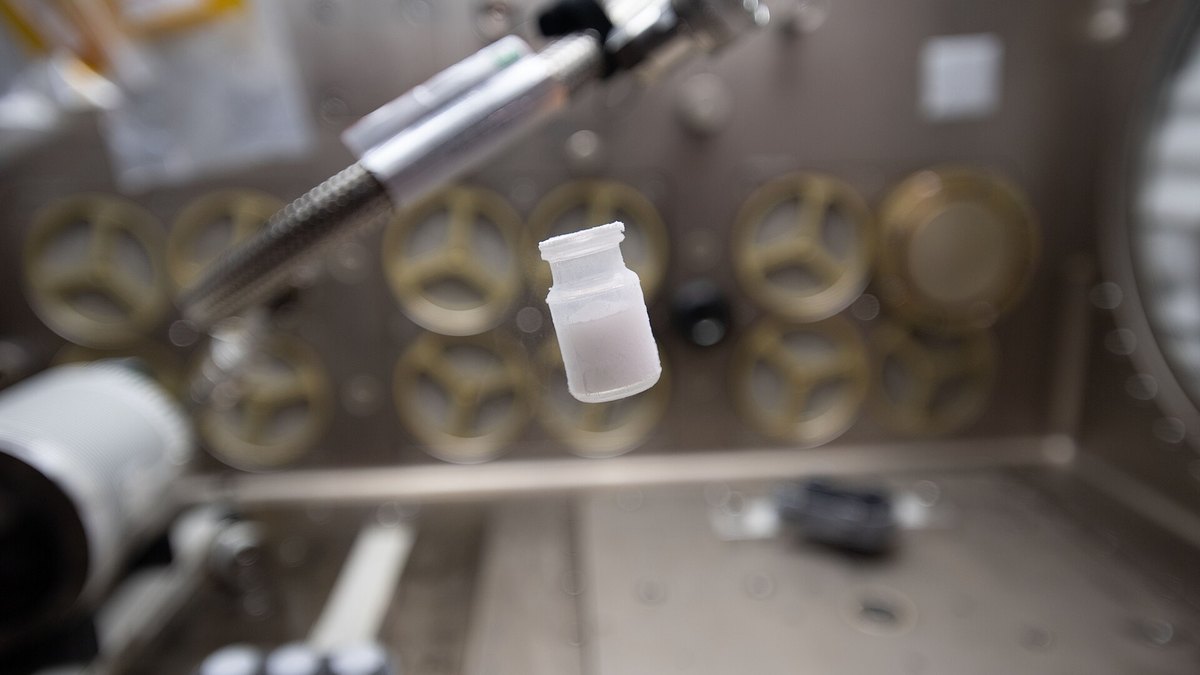
OxyDeplete™ is Panacea Bio Chem's proprietary gas-depletion technology for reducing dissolved, entrained and accessible atmospheric gases in dry-product and liquid pharmaceutical systems before controlled argon conditioning and container completion. In a dried peptide cake it draws accessible pore, entrapped and chamber gas out of the porous solid; in a liquid it removes dissolved gases and entrained microbubbles. OxyDeplete removes the gas — it does not supply the argon or form the seal: ArgonLock™ establishes the argon-conditioned state, the Vana Machine™ controls the vacuum and closure, and the container-closure preserves the condition. By lowering accessible molecular oxygen1 ahead of argon conditioning, OxyDeplete protects oxidation-prone residues (methionine, cysteine, tryptophan) in peptides and biologics. Within qualified Panacea formulations and container architectures, the integrated OxyDeplete™ preservation process has demonstrated stability extending into years. The rough principle is described here; the exact degassing parameters remain proprietary to Panacea Bio Chem.
A dried peptide holds its potency far longer when one quiet variable is taken off the table. That variable is oxidation1, the slow reaction between the molecule and the oxygen sealed in alongside it — and it is one of the most controllable factors in a product's shelf life. Three residues carry most of the exposure — methionine oxidises to methionine sulfoxide2, cysteine thiols scramble into disulfides, and tryptophan and histidine open under reactive-oxygen attack6. None of this needs heat or light to begin; ground-state molecular oxygen, given months, is enough. The result is a lower potency, a new impurity peak, or an aggregation seed — degradation that was written into the vial the moment it was closed with air still inside.
Every sealed vial carries a headspace: the void above the product, normally filled with room air at roughly 21 % oxygen. That trapped oxygen is a finite but sufficient reservoir — it does not escape, it reacts. For an oxidation-sensitive sequence, headspace oxygen is a primary determinant of how long the product stays intact in storage. Many conventional lyophilization cycles remove water with great care, then close the cake back up under air — solving one degradation pathway while leaving the oxidative one open. Not every lyophilised product is air-sealed, but wherever accessible gas is left in, OxyDeplete depletes it before the container is completed.
OxyDeplete treats gas as the control variable. Rather than accept whatever gas a unit happens to contain, the accessible gas is drawn out before the container is completed — in a dried cake the accessible pore gas, entrapped gas and chamber atmosphere; in a liquid the dissolved gases and entrained microbubbles. OxyDeplete performs the gas removal only: it does not backfill the argon and it does not form the seal. The argon then arrives in two distinct events. First, as the Lyochrysalis™ lyophilisation cycle closes, argon admitted by ArgonLock™ replaces all the vacuum over the dried cakes — a full argon backfill of the porous solid. Later, once the cartridge is capped, the Vana Machine™ draws the Lyoprester® dry (first) chamber back to an absolute vacuum and replaces only a fraction of that vacuum with argon before locking the closure — leaving a vacuum-derived, strongly oxygen-reduced chamber that sits at reduced pressure carrying partial argon, not a headspace ‘backfilled’ at atmospheric pressure. This mirrors, at pharmaceutical precision, the food-and-pharma logic of modified-atmosphere packaging3 and oxygen scavengers4: control the gas, and you control the chemistry.
Steps [01]–[06] describe the principle only, and the argon is admitted by ArgonLock™ — not by OxyDeplete. The pressures, dwell times, gas selection and closure hardware that make the depletion repeatable are not disclosed.
| Parameter | Conventional air-sealed vial | OxyDeplete |
|---|---|---|
| Internal gas condition | Room air (~21% O₂) | Vacuum-derived, reduced-pressure partial argon (ArgonLock™) |
| Chamber state at closure | Full air-filled void above product | Absolute vacuum, a fraction replaced with argon |
| Residual oxygen | Ambient, trapped | Very low |
| Oxidation driver present | Yes — for the whole shelf life | Accessible gas depleted before conditioning |
| Target degradation path | Met / Cys / Trp oxidation active | Oxidative path suppressed |
| Best-fit product | Oxidation-stable molecules | Oxidation-prone peptides & biologics |
The advantage is mechanistic, not cosmetic: OxyDeplete does not slow oxidation with an additive that must itself be justified in the formulation — it depletes the accessible gas so the argon conditioning that follows works against a much lower oxygen load. Molecular oxygen is a major contributor to several oxidative pathways, while RedoxVault™ addresses formulation-specific risks involving peroxides, reactive species, trace metals and other redox-active contaminants.
Gas depletion is strongest inside a formulation-integrity chain rather than bolted on at the end. OxyDeplete hands off within Panacea's gentle drying and inert-conditioning stack. Product is freeze-dried by Cryolapse™ — freeze-drying the way nature would →; OxyDeplete then depletes the accessible gas; ArgonLock™ — controlled argon conditioning → establishes the argon-conditioned state across its three faces — dissolved argon in the P-EARLs™ diluent, dissolved argon in the Liquiprester™ liquid, and gas-phase argon in the Lyoprester® dry chamber, where argon first replaces all the vacuum as the Lyochrysalis™ cycle closes and is later reduced by the Vana Machine™ to a partial argon fill of a re-drawn vacuum; and the Vana Machine™ conditions the vacuum and locks the closure. Each technology owns one step: OxyDeplete removes the gas, ArgonLock supplies and conditions the argon, Vana controls the vacuum and closure, and the container-closure preserves the condition over shelf life. Where the surviving risk is redox rather than gaseous, RedoxVault™ provides formulation-specific protection. The choreography across these stages is watched by the S3Pulse™ control algorithm →.
A low-temperature finish. Panacea's lyophilisation is not a hot process. Coordinated by Lyochrysalis™, S3Pulse™, DiastolVAC™, TgShift™, Cryolapse™ and LyoLevit™, the cycle finishes at −3 to −5 °C — primary drying (sublimation) ending at −8 to −10 °C and secondary drying (desorption) ending at −3 to −5 °C — with none of the +40 to +60 °C secondary-drying overheat that mainstream lyophilisation consensus requires. Removing that thermal stress preserves the binding affinity and bioavailability of the finished peptide, so OxyDeplete gas depletion goes on to protect a molecule that was never overheated in the first place.
Two further Panacea methods sharpen the depletion at the two moments that matter most — drawing the gas out, and keeping it out. The degas step is shaped by DiastolVAC™ — vacuum with a heartbeat →, whose gentle, pulsed pressure curve coaxes adsorbed gas out of a delicate cake far more evenly than a single hard vacuum, so the depletion reaches deep without stressing the product. And once the unit is sealed, the Vana Machine™ — the seal that stays put → conditions the closure under vacuum and locks it, so no plunger drift or slow in-leak lets an air gap — and its oxygen — creep back over the shelf life. Together they mean the very low oxygen established by OxyDeplete gas depletion and ArgonLock argon conditioning is the same low-oxygen condition the product still sees months later. Within qualified Panacea formulations and container architectures, that integrated process has demonstrated stability extending into years.
Panacea's newest contribution. OxyDeplete is Panacea Bio Chem's latest step in a longer programme of oxygen-exclusion research: taking accessible-gas depletion beyond a single fill-line trick and into a repeatable, integrity-controlled stage of the peptide workflow. What sets it apart — how the depletion is driven and held — is held in-house.
OxyDeplete™ is a proprietary Panacea Bio Chem gas-depletion technology developed and invented by Bogdan Dicoias; its operating parameters are not publicly disclosed. The rough principle is stated above — the exact degassing pressures, dwell times and the argon-conditioning handoff that make OxyDeplete repeatable stay behind the door.
Excluding oxygen to buy shelf life is one of the oldest preservation moves there is, and industry proved it at scale long before pharma refined it. A vacuum- or nitrogen-flushed pack of coffee, a nitrogen-topped wine, a sachet of iron powder tucked beside dried food — each is the same idea: take the oxygen out of the container and the contents stop ageing. Modified-atmosphere packaging3 swaps air for inert gas; oxygen scavengers4 chemically mop up whatever remains; both are everyday defences against autoxidation5, the slow, spontaneous reaction of organic matter with air. OxyDeplete carries that well-worn food-and-pharma logic to the precision a fragile peptide demands: not "less" oxygen, but as close to none as a sealed vial allows.
“Residual oxygen” is two different measurements wearing one name, and they are not interchangeable. In a liquid, dissolved oxygen is counted in parts per million (mg/L) — air-saturated water at room temperature holds roughly 8–9 ppm. In a sealed dry unit, headspace oxygen is a gas-phase fraction, counted in percent by volume. Henry’s law connects the two regimes through the gas–liquid equilibrium, but a number from one regime says nothing direct about the other — the confusion is real enough to live inside the patent literature itself, where one packaging document equates “1% residual oxygen” with “~400 ppb” without stating which regime it means12. A residual-oxygen figure means nothing until its regime travels with it.
| Reference point | Regime | Reported level | Source (tier) |
|---|---|---|---|
| Inert-gas sparging of water, 20–40 min | Dissolved (liquid) | 0.2–0.4 ppm residual; no technique removed all oxygen | Butler et al., Talanta 1994 (primary)7 |
| Epinephrine fill-finish process | Dissolved (liquid) | Water for injection nitrogen-purged to below 1 ppm dissolved O₂ before compounding | US 11,234,925 (patent)10 |
| L-cysteine injection family | Dissolved (liquid) | Dissolved O₂ held below about 2 ppm as the stability strategy | US 10,653,719 family (patent)11 |
| Lyophilized peptide vials, 25 °C / 3 months | Headspace (gas) | Related substances tracked against measured headspace O₂; “preferably less than 3.0%” | US 12,491,229 (patent)8 |
| IL-17 antibody vials | Headspace (gas) | Related-substances difference between 5% and 20% headspace O₂ | US 12,296,008 family (patent)9 |
| Oxygen-scavenging package | Enclosed package | Scavenger claimed to take oxygen “to zero percent” — a packaging-patent claim, not an independent measurement | US 2006/0076536 (patent application)14 |
Two orientation facts frame every number above. First, water for injection itself carries no pharmacopoeial dissolved-oxygen specification: the USP monograph limits conductivity, total organic carbon, endotoxin, microbial count and pH — and says nothing about dissolved oxygen, so any “WFI oxygen spec” quoted without a source is folklore. Second, oxygen displacement for oxidisable injectables is long-standing written practice, not a novelty: the Chinese Pharmacopoeia (2020, general chapter 0102 on injections) directs that container air be displaced with carbon dioxide or nitrogen and the container sealed immediately for air-sensitive drugs, and the Soviet-school parenteral canon teaches gas-saturation of water for injection to the same end. Where a finished product lands between a few ppm dissolved and a few percent headspace is therefore an engineering decision with published precedent on both sides — and it is the decision OxyDeplete exists to drive downward before ArgonLock™ conditioning and the Vana Machine™ closure hold it there.
The classic defence for an oxygen-sensitive drug was to add an antioxidant — sodium metabisulfite being the workhorse — and let it be consumed in the molecule’s place. That route has real costs: sulfite reactions in some patients pushed the field toward products that could do without, and every antioxidant added is one more excipient to justify, one that is spent as it reacts. The alternative — remove the oxygen instead of sacrificing an additive to it — is not a theory. It is written into product and patent history:
OxyDeplete stands in that lineage. An antioxidant sits inside the formulation and is consumed as it reacts; OxyDeplete withholds the oxidiser from the product and its container instead — the two levers can be combined, and the cases oxygen removal cannot reach (peroxides, trace metals, reactive species carried by excipients) belong to RedoxVault™ by design.
What does OxyDeplete stand for?
OxyDeplete stands for Oxygen-Depleted
Sealing — Panacea Bio Chem's gas-depletion technology, in which the accessible
gas is depleted from dry product or liquid before the container is completed under
controlled vacuum with limited argon conditioning, so the finished unit sits at very low
residual oxygen. OxyDeplete removes the gas; ArgonLock™ supplies the argon and the
Vana Machine™ forms the closure.
Why does headspace oxygen matter for peptides?
The oxygen trapped in a
sealed vial does not leave — it reacts. Over months it oxidises methionine,
cysteine and tryptophan, lowering potency and raising impurities. Removing that
oxygen at seal time addresses the oxidative ageing path at its source.
Does OxyDeplete replace antioxidants in the formula?
It works on a
different lever. Antioxidants sit inside the formulation and are consumed as they
react; OxyDeplete withholds the oxidiser from the package instead. The two can be
combined, and OxyDeplete complements the redox approach of RedoxVault™.
Who developed OxyDeplete?
OxyDeplete was developed by Bogdan
Dicoias and is the intellectual property of Panacea Bio Chem Ltd —
alongside the Cryolapse™ lyophilization method, the Lyoprester®
cartridge and the ArgonLock™ inert-gas system. The exact parameters are
proprietary.
Recent developments in the field — refreshed 2026-10-12 by Panacea Bio Chem.
OxyDeplete’s gas-depletion principle covers every liquid Panacea processes — not only the cartridge fill liquids but the peptide solution itself, before it is lyophilised. OxyDeplete™ and ArgonLock™ are applied to all three: the peptide solution ahead of freeze-drying, the P-EARLs™ diluent, and the Liquiprester™ precision liquid cartridge. In each, the liquid is degassed to remove dissolved atmospheric gases, entrained microbubbles and accessible oxygen before argon conditioning — so the active enters the dry cake, and each cartridge is filled, from an already oxygen-depleted, argon-conditioned starting point. OxyDeplete removes the gas; ArgonLock™ then establishes the argon-conditioned state by dissolving controlled argon into the liquid, and ElimiVoid™ geometrically completes the front void — together giving a cartridge with no visible air bubble, within a near-airless, oxygen-depleted, argon-conditioned environment. Those cartridges are filled on the PleniDose™ Gantry, conditioned into the Cryoviscous™ state, protected by RedoxVault™, and dose-mapped per increment by IncreSure™.
The Panacea Technology Universe
Proprietary Panacea Bio Chem Ltd technologies, invented by Bogdan Dicoias — what each one does, and why it leads its class.

 Lyoprester®The only dual-chamber cartridge that is autoreconstitution-enabled, vacuum-sealed and argon-fillback.lyoprester.com ↗
 P-EARLs™Panacea-Engineered Aseptic Reconstitution Liquid(s) — each tuned to the peptide it wakes.p-earls.com ↗
 Peptourbillon™The layered peptide formulation architecture — single- or multi-layer, never a blend.peptourbillon.com ↗
 RF Tunnel™The RF-formed central channel through the cake.rftunnel.com ↗
 TgShift™Raises the cake’s glass-transition temperature with RF — instead of chilling below it.tgshift.com ↗
 Cryolapse™Cryogenic pressure collapse under S3Pulse™ control — vapour redistributed through the whole cake, not its surface, impeding crust formation.cryolapse.com ↗
 LyoLevit™The cake levitates and spins in high orbit — driven by ultrasound and RF.lyolevit.com ↗
 Lyochrysalis™The integrated chamber housing the whole drying stack.lyochrysalis.com ↗
 S3Pulse™The control brain for every piece of Panacea hardware.s3pulse.com ↗
 Liquiprester™The single-liquid cartridge engineered so multiple peptide APIs coexist in one shared vehicle.liquiprester.com ↗
 Syntheseract™Continuous-flow peptide synthesis in a special, very fast and economical way.syntheseract.com ↗
 CFSPPS™Continuous-flow solid-phase peptide synthesis, written as its own category.cfspps.com ↗
 OxyDeplete™Degassing plus no-headspace doctrine — the oxygen-starved seal.oxydeplete.com ↗
 ArgonLock™The final inert-atmosphere lock under argon.argonlock.com ↗
 RedoxVault™Separation, not merely suppression — redox isolation in lipid micro-reservoirs.redoxvault.com ↗
 PleniDose™The shared filling gantry — one machine filling both the dual-chamber Lyoprester and the liquid Liquiprester.plenidose.com ↗
 IncreSure™The dose-metrology layer — verified API per pen increment.incresure.com ↗
 ElimiVoid™Front-void elimination without touching the metered dose.elimivoid.com ↗
 Cryoviscous™The characterised cold, high-viscosity, low-mobility conditioning state.cryoviscous.com ↗
 Vana Machine™Vacuum–Argon–Nitrogen Architecture — draws the air and nitrogen out of the cake and backfills with argon; in a separate process, the same machine makes the P-EARLs bubble-free.www.vanamachine.com ↗
 EZnject™The disposable auto-injector pen built around the Lyoprester.panaceaeznject.com ↗
 Dicoias ΨThe computed-chemistry advisory — every substance reduced to a vector across physical, electronic and formulation space.dcppsi.com ↗
 SealoPrester™Aseptic Cartridge Closure System — Seal o’ Precision + Sterility.sealoprester.com ↗
 Peptidic LiquidThe peptide formulation in solution — the active plus its buffers, cryoprotectants, lyoprotectants and scaffolders.peptidicliquid.com ↗
 DiastolVAC™Biomimetic diastolic vacuum control — the pneumatic circulatory system of the machine: pumps, valves and sensors as one ensemble.diastolvac.com ↗
 KineticON™Motion Integrity Architecture — the motion-control layer that lets the machine know what happened on every axis move.kineticon.org ↗
Publications indexed in PubMed in the last 30 days for protein oxidation methionine OR peptide oxidative degradation formulation — refreshed weekly.